University
of Alaska Fairbanks
Department of Chemistry and Biochemistry
Improvements in the PM6 Semiempirical Quantum Method
Since the introduction of the original "parameterized methods" PM3 and PM6, several variations, including PM6-D3H4 and PM7, have appeared. These are listed in the MOPAC manual webpage under Keywords. When using the above methods in WebMO, they can be selected in the MOPAC Theory drop-down menu. For the more obscure methods, edit the first term in the input file after selecting Generate on the Preview tab.
The PM6-D3H4 method was published in 2012. Like most such papers, this one contains a lot of equations, however the most useful results are contained in tables that compare the methods. For example, see Table 5, column 1, which refers to the S66 benchmark database of noncovalent complexes where the average error of PM6-D3H4 is about 20% that of PM6. [1] The S66 complex database is described in a 2018 paper. [2]
PM7 is another improvement developed by J. J. P. Stewart, who is the original PMn developer. [3]
The overall best semiempirical method IMO is GFN2-xTB (or xTB for short) developed by Stefan Grimme and co-workers in Germany. Besides the rather accurate single molecule calculations, it can do molecular dynamics and other tricks. The full description is here. [4]
PM6, PM6-D3H4, and xTB are compared to density functional theory in calculations of enzyme active sites in a paper by Kriz. PM6-D3H4 does quite well in this case. [5]
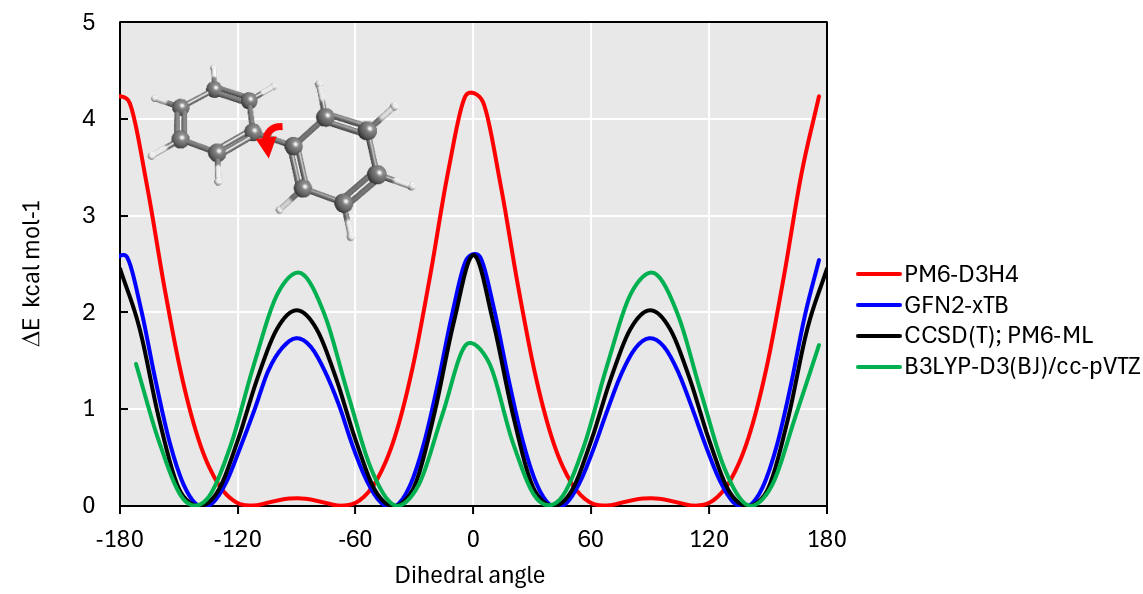
Finally, a recent addition is the use of machine learning to calculate improved parameters for PM6. Unfortunately, PM6-ML is not available in MOPAC. In some cases, such as predicting the energies of biphenyl conformations, PM6-ML nearly matches the "gold standard" ab initio method CCSD(T). PM6-D3H4, on the other hand, has a hard time with biphenyl conformations. [6]
[1] Rezac, J.; Hobza, P. Advanced Corrections of Hydrogen Bonding and Dispersion for Semiempirical Quantum Mechanical Methods. Journal of Chemical Theory and Computation 2012, 8 (1), 141-151. DOI: 10.1021/ct200751e.
Contact: jwkeller-at-alaska.edu
The University of Alaska Fairbanks is an affirmative action/equal opportunity employer and educational institution and is a part of the University of Alaska system.