Gaussian Thermochemistry
Originally by Prof. Hendrik Zipse, this page has been modified by John Keller, University of Alaska Fairbanks (2026). Most of HZ's text is used, but here the δEvib equation graphic is corrected, and a somewhat more complex example is shown: water dimer (H2O)2. Unlike Zipse's H2 molecule, the water dimer has several low frequency vibrations that affect the thermochemical properties.
A detailed account of how thermochemical values are calculated in Gaussian
by Joseph W. Ochterski (Gaussian Inc.) is available
here as a pdf file.
A number of constants and conversion factors helpful in thermochemical calculations can be
found here.
The thermochemical analysis in Gaussian is based on the harmonic vibrational frequencies
calculated in OPT FREQ or FREQ jobs. The thermochemical values are calculated at 298.15K and 1.0 atm
unless otherwise stated in the input file.
______________________________________________________
The Gaussian input file for this calculation is as follows:
#N B3LYP/6-311++G(2d,p) OPT=vtight FREQ
EmpiricalDispersion=GD3 NOSYMMETRY
2wat-6311ppG2dp-b3lyp-d3-opfr
0 1
O 0.00000000 0.00000000 0.00000000
H -0.43754800 -0.39439800 0.76183900
H -0.43000000 0.85290100 -0.12257500
O 2.83628100 0.06678700 0.14314900
H 1.86727000 0.03697100 0.08186300
H 3.15093 -0.47229
-0.5878
____________________________________________________
The complete
Gaussian output file
________________________________________
The key thermochemical properties are as follows:
SCF Done: E(RB3LYP) = -152.929043813 A.U. after 1 cycles

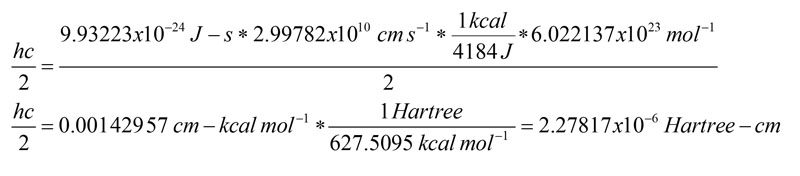
For the water dimer there are 12 vibrational modes. With 0.5hc = 2.27817*10-6 cm-hartree, we obtain a
zero point vibrational energy of 0.046225 hartrees after adding up the 12 values
(see column 2 in the table below). This result is given on line 4012 of the Gaussian
output file as:
Zero-point correction= 0.046225 (Hartree/Particle)Conversion to Joules or kilocalories gives using 627.5095 Kcal Mol-1 hartree-1:
Zero-point vibrational energy      121364.3 (Joules/Mol)
                                   29.00675 (Kcal/Mol)
E0 = Etot + ZPVE
This result is listed in the output file (line 4016) as:
Sum of electronic and zero-point Energies= -152.882819
E(0-298) = δEel + δEvib + δErot + δEtrans
The first of these terms δEel describes the contribution of electronically excited states to the internal energy of the system. With excitation energies even to the first electronically excited state being much higher than kBT at room temperature and with the zero point of energy taken as the electronic energy of the ground electronic state, there is usually no contribution to the internal energy from occupation of electronically excited states at room temperature. Therefore, δEel = 0.
By far the largest contribution to the internal energy at room temperature stems from vibrational degrees of freedom, the zero point vibrational energy being one important component. The occupation of higher vibrational levels gives rise to an additional contribution δEvib which can be calculated according to:
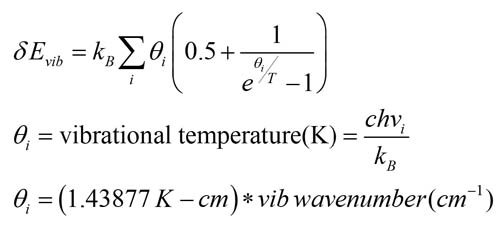
The vibrational temperature of each mode i is not only a helpful quantity for evaluation of E(0->298) using the above equation, but also serves as a qualitative indicator for the extent of thermal excitation of a vibrational mode. In the example of (H2O)2, five vibrational modes have low frequencies and vibrational temperatures, which will slightly increase δEvib over the zero point energy. Adding them up as follows
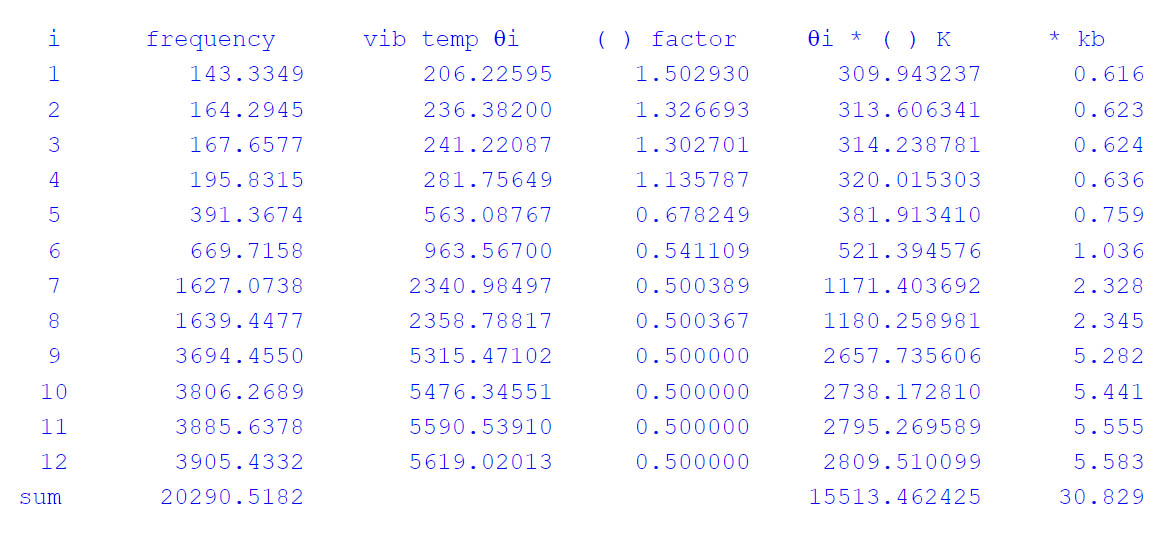
Then δEvib = 0.00198722 kcal mol-1 K-1* 15513.46242 K = 30.829 kcal mol-1 . Gaussian does this automatically; there is no need to calculate it manually. But this is where "30.829" in column 2 of the table below (line 4027 in the log file) comes from. ( E (thermal) column as "Vibrational").
The spacing of rotational energy levels is much narrower than that of vibrational energy levels. An approximate formula for the contribution of rotational energy levels to the internal energy at room temperature (or above) for an asymmetric top is:δErot = 3/2 RT
And so the contribution of rotational motion to the internal energy at 298.15K is 0.8887 kcal/mol (or 3.7185 kJ/mol).
The translational energy of an ideal gas δEtrans at temperature T is given (in molar quantities) as
δEtrans = 3/2 RT
implying that at 0 K there is no contribution to the internal energy from translational motion, but that the translational energy increases linearly with increasing absolute temperature. At 298.15 K this amounts to 0.8887 kcal/mol (or 3.7185 kJ/mol).
Thus the total thermal correction = 30.829 + 0.8887 + 0.8887 = 32.606 kcal
mol-1 = 0.051961 hartree
The overall value for E(0-298) appears together with the ZPVE as "Thermal correction to Energy":
Zero-point correction=                           0.046225 (Hartree/Particle)
Thermal correction to Energy=                    0.051961
To repeat what was said above: The individual components of the internal energy at 298.15K are listed a few lines below in the following format (together with contributions to heat capacities cv and entropies S): (For displaying this table, Gaussian rounds Translational and Rotational values to 3 decimal places, however the Total values are correct to 3 decimal places because in the background, the program's arithmetic steps do not round off.)
                     E (Thermal)             CV                S
                      KCAL/MOL        CAL/MOL-KELVIN    CAL/MOL-KELVIN
 TOTAL                   32.606             15.956             69.028
 ELECTRONIC               0.000              0.000              0.000
 TRANSLATIONAL            0.889              2.981             36.674
 ROTATIONAL               0.889              2.981             21.110
 VIBRATIONAL             30.829              9.994             11.244
 Vibration 1              0.616              1.910              2.759
 Vibration 2              0.623              1.886              2.500
 Vibration 3              0.624              1.882              2.462
 Vibration 4              0.636              1.846              2.172
 Vibration 5              0.759              1.489              0.995
Sum of electronic and thermal Energies= -152.877083
H298 = E298 + PV = E298 + RT
the latter equality being valid for molar quantities of an ideal gas. (kBT is used for one particle.) At 298.15K, RT = 0.592490 kcal mol-1 or 0.0009442 hartree. This is the difference between the thermal energies and enthalpies listed in the output as:
Sum of electronic and thermal Enthalpies= -152.876139
Sum of electronic and thermal Free Energies= -152.908936
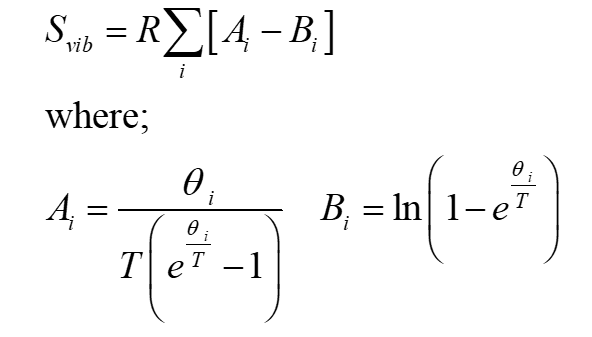
The S298 factor is
calculated in the background using standard formulas. For example, Strans
is calculated by the Sackur-Tetrode equation. Svib is
calculated as shown below: (from
the Q-Chem website 2026)
| cm-1 | K | ||||
| ni | qi | q/298.15K | Ai | Bi | Ai-Bi |
| 143.335 | 206.23 | 0.692 | 0.6937 | -0.6946 | 1.38832 |
| 164.295 | 236.38 | 0.793 | 0.6554 | -0.6025 | 1.25793 |
| 167.658 | 241.22 | 0.809 | 0.6494 | -0.5893 | 1.23872 |
| 195.832 | 281.76 | 0.945 | 0.6008 | -0.4921 | 1.09295 |
| 391.367 | 563.09 | 1.889 | 0.3366 | -0.1640 | 0.50067 |
| 669.716 | 963.57 | 3.232 | 0.1329 | -0.0403 | 0.17314 |
| 1627.074 | 2340.98 | 7.852 | 0.0031 | -0.0004 | 0.00345 |
| 1639.448 | 2358.79 | 7.911 | 0.0029 | -0.0004 | 0.00327 |
| 3694.455 | 5315.47 | 17.828 | 3.224E-07 | -1.809E-08 | 3.405E-07 |
| 3806.269 | 5476.35 | 18.368 | 1.937E-07 | -1.054E-08 | 2.042E-07 |
| 3885.638 | 5590.54 | 18.751 | 1.348E-07 | -7.189E-09 | 1.420E-07 |
| 3905.433 | 5619.02 | 18.846 | 1.231E-07 | -6.534E-09 | 1.297E-07 |
| sum = | 5.6585 | ||||
| R*[] | 11.24 | ||||
| cal/K-mol |