
University of Alaska Fairbanks
Department of Chemistry and Biochemistry
Updated 8-17-2026 Contact: jwkeller/at/alaska.edu
More Details
| Server |
Cores/ Threads |
Cores (=processors) available | Memory (GB) | Processor |
| Antec12
(default) |
16/32 | 24 | 64 | AMD 9950X |
| Trx40 | 24/48 | 24 | 128 | AMD threadripper 3960X |
| Corsair | 16/32 | 24 | 64 | AMD 7950X |
| Merlin | 16/32 | 24 | 64 | Intel i9-13900X |
Use B3LYP-D3(BJ) for research grade
calculations. We have used and recommended the world's most
popular DFT method B3LYP for years, however, this functional has a
serious shortcoming in not properly taking into account London
dispersion forces. This is an issue for larger molecules and noncovalent
complexes, but not so much for small molecules. This option is available
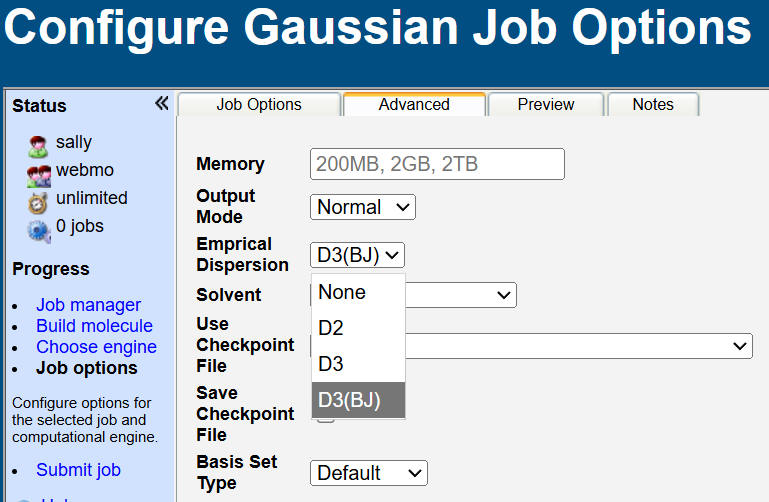
in Gaussian by selecting "D3(BJ)" in the Empirical Dispersion dropdown
menu in the WebMO Advanced tab as shown below. (D3 is the third
dispersion correction introduced by Stephan Grimme some years ago; BJ
stands for Becke-Johnson damping, which is a "correction on the
correction.")
In ORCA, one must enter the dispersion correction manually in the
input file. Also note that MP2 and CCSD(T) already correct for
dispersion; do not attempt to apply D3(BJ) with these methods. Two
references with further documentation are the
ORCA manual and a 2025 paper on
drug molecule calculations.
WebMO Demo tutorial - H2O.
How do you
interpret the thermochemistry section in the output of a
Gaussian frequency job?
That is, what are ZPE,
Internal Energy, Enthalpy, and how does Gaussian derive these
values?
An explanation, including an example, is available
here.
(While rather long, it's shorter than the authoritative
whitepaper on thermochemistry
by Joseph Ochterski of Gaussian, Inc.)
What are Natural Bond
Orbitals
(NBOs)?
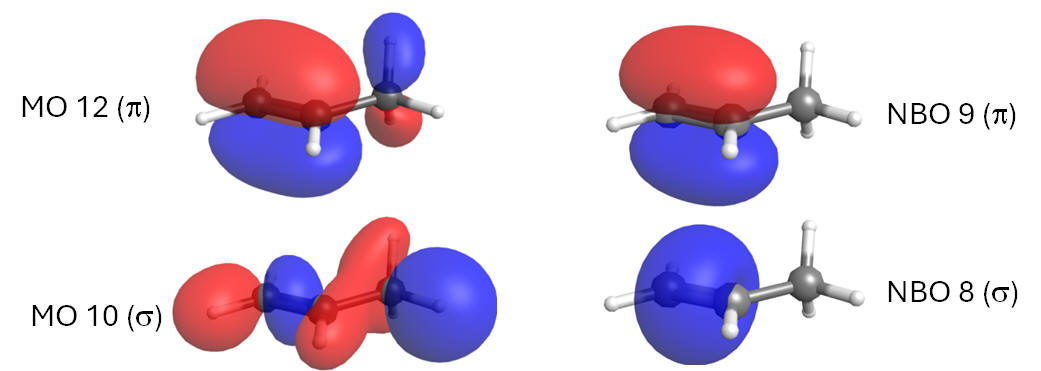
NBOs are localized orbitals derived mathematically from
the normal MOs. They reflect the molecule's bonding as suggested by a valence
bond model or a Lewis formula. That is, NBOs correspond to isolated sigma (σ) bonds, pi (π) bonds,
or lone pairs. For example, propene:
NBO version 7 is accessed through Gaussian or
ORCA. In WebMO's "Configure Job Options"
page, select a "Natural Bond Orbitals" calculation. Both MOs
and NBOs will be shown on the Results page. View the NBO 7
MANUAL
here.
Gaussian version. ORCA version.
Here are example files: output.log and output-mod.log for the Cl-..CH3F complex.
Why bother? Because GV5's vibration analysis and animations are way better than those of WebMO.
The above workaround was published several years ago on Dr. Joaquin Barroso's computational chemistry blog (https://joaquinbarroso.com/2018/01/29/chk-files-gaussview/)
WebMO https://www.webmo.net
MOPAC https://openmopac.net
Gaussian https://www.gaussian.com
ORCA: https://www.faccts.de/orca/
xTB: https://xtb-docs.readthedocs.io/en/latest/